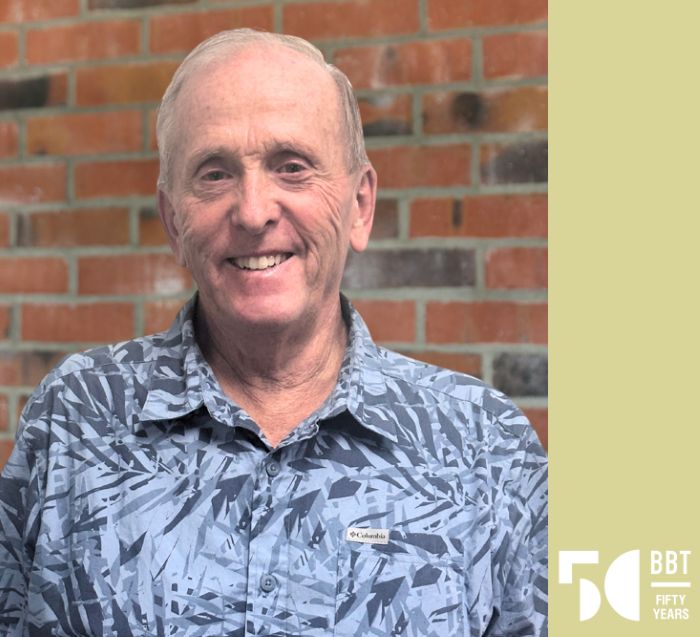
As part of BBT’s 50th anniversary, this series reflects on the people, projects, and ideas that have shaped our firm across five decades. Through conversation, we explore where we began, how we practice today, and what lies ahead.
Early Influences and the Path to Architecture
One of the three founding partners of BBT Architects, Ron Barber traces his interest in architecture back to 6th grade when an observant teacher noticed the quality of his drawing skills and had him doing a lot of drawing projects. His fascination with design continued to develop and somewhere along the line, he decided that architecture was what he wanted to pursue, so after high school, he enthusiastically entered the University of Oregon’s architecture program.
The Vietnam War draft was active during Ron’s college years, though a four-year deferment from military service was allowed for college students. After university graduation, the war draft process resumed, and he joined the National Guard. Ron also started practicing architecture in Bend with a one-man shop, Gil Helling. By the time he left the firm, there were about a dozen people onboard, including Dave Waldron as a lead designer. For several years thereafter, Ron invested in training and practice with ZGF, a renowned design firm in Portland, Oregon.
Returning to Bend and Founding the Firm
Dave Waldron contacted Ron on several occasions during his time in Portland and regularly mentioned his “good friend and excellent designer”, Neal Huston, working in Black Butte Ranch. Dave eventually persuaded Ron that the time was right for Bend to explode and convinced him to collaborate in establishing a firm ready for growth and development in Central Oregon. Ron finally accepted the invitation, returned to Bend, and the three formed (WHB) Waldron Huston Barber Architects in 1976.
After navigating the 80s recession, and various transitions and mergers, Dave Waldron departed and the collective expanded to include Jim Barrett and Todd Turner as partners in 1985. After Neal Houston launched his own residential design practice in 1988, Barber, Barrett, and Turner abbreviated the firm’s name to BBT Architects.
Shaping BBT: Leadership, Education, and Community Impact
During his tenure with BBT, Ron gravitated into overall management, technical issues, and sustainability, becoming one of the first architects to be certified as a LEED design professional. He played a major role in K-12 educational projects in multiple school districts and was foundational in the development of long-term client relationships with the Redmond School District and Bend La Pine School District.
Obsidian Middle School in Redmond, La Pine High School, Sisters Middle School, and several LEED certified elementary schools were among the first full school projects completed by BBT. Mt. Bachelor was also a major client with BBT providing comprehensive design services for the lodges, ski lifts, and construction administration on all projects.
Beyond BBT: Reflection, Legacy, and What Endures
Ron’s final major design project with BBT was a renovation of the historic Crane Shed building in the Old Mill District into a multi-story, luxury living, mixed-use building: the Mercado. At the time, it was the largest project the firm had ever executed through construction documents, but it was never built due to the structure being mysteriously demolished overnight. In 2010, Ron charted a new course beyond BBT and ventured to Oahu, Hawaii where he continues to practice architecture to this day!
Reflecting upon his work with BBT, Ron stated, “The projects were projects (with highlights and challenges). We were kind of at the right place at the right time for a long time…now you guys have the legacy. In his recollections about BBT as a firm, he shared, “I don’t end up talking about the projects…it was more the camaraderie, the friendships, and really a sense of family. We grew up together; we had office events, office dinners, office outings. I remember ice skating, sled rides, and the things we did as a group. That’s what I always end up talking about.”